Trip to Slush
A platformer built live on Twitch during summer 2018, in the Dev du jardin series: 18 episodes, a first playable build on itch.io after 14 hours of streaming, and three Unity packages born along the way.
What if we made a game together? All summer 2018, three times a week, I built a platformer live on Twitch (in French), with some humour, a view of a calm summer garden, and a few good practices along the way. The project started as “the summer dev” and quickly became Dev du jardin (“garden dev”), simpler and more fitting, and also a nod to Lola, la Dev du Dimanche (“the Sunday dev”), whose work and videos I found really good.
A playable game in 14 hours of streaming
The first episode started from an empty project on July 6. On August 8, in episode 14, the game was out on itch.io: a real early game, built almost entirely live (18 hours of development in total, 14 of them on stream).
The idea: a character runs through a series of level sections (chunks) assembled on the fly. The game records how players collect the globes, and this trend shapes the design of the next levels. In the episode 17 wrap-up, I even invited players to try and reverse the trend.
What I hadn’t expected was the pace: with streams of one to two hours at most, every episode showed a new working building block. I didn’t think I would get that far, and it was both rewarding and exhilarating. Not always easy for a streaming beginner, though: on top of that, Stéphane was sometimes in the same room, commenting live to throw me off. The graphics he provided along the way, while he worked in the same studio as me, gave the final game real character.
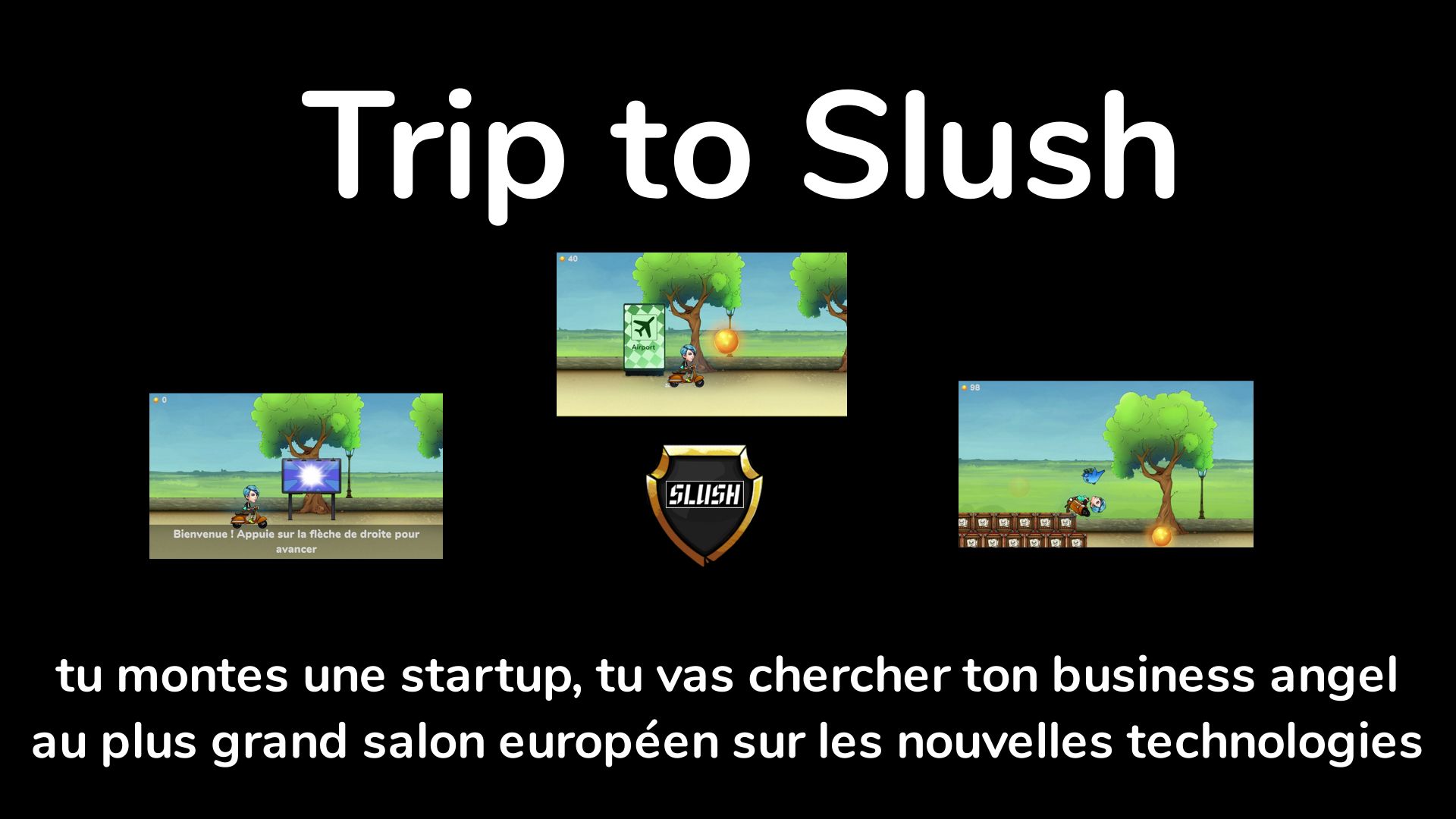
The game is still playable on itch.io: in Trip to Slush, you start a startup and go looking for your business angel at Europe’s biggest tech conference.
A one-person show
I did everything: development of course, but also planning and chaptering each stream, setting up the streaming tools with a green screen, hosting live, then editing the replays with DaVinci Resolve, which I discovered for the occasion.
It was a test: a bit too shy to really promote it, I didn’t get many viewers, but the exercise was worth it.
What we covered
- The basics: Git repository and one-way platforms you can jump through, procedural level design in three lines, TileMaps, a 2D character rigged with bones.
- Architecture: customising the avatar with ScriptableObjects, then an introduction to ECS and moving the character to ECS, brand new in Unity at the time.
- Content: asynchronous data sharing with BrainCloud, a home-made level editor, Cinemachine, animations and parallax, birds to add rhythm.
- Polish: transitions and shaders, controlled randomness with a bucket and Perlin noise, localization and text tools, then gamepad support, with music and sound.
If you missed the start, a summary of the first nine streams takes three minutes.
What’s left of it
Three tools written during these streams became open source Unity packages I still use: the bucket (Bucket Generator), screen transitions (Screen Transitions) and localization (Simple Localization).
I would have liked to go back to streaming: a 2D physics tutorial was even ready for September. But between COVID, a job change and a home connection too weak for it, that wasn’t possible. So I focused on reworking and sharing these assets, and that is what really worked afterwards: all the way to a complete sample game in GameQuest.
The code of the first five episodes is public on Bitbucket; the rest continued in a private repository (a matter of rights).
When’s the next stream?