Bubble Hunter
Bubble wrap to pop on a phone screen: a tiny mobile game shipped in a few weeks in spring 2016, which later became Easter Hunter, then the testing ground for our free-to-play building blocks, from quests to save data.
A grid of bubbles, one finger, and that small pleasure everyone knows: popping bubble wrap. Bubble Hunter brings that gesture to a phone screen. You tap the bubbles, they pop, you earn coins, and those coins unlock bigger, pricier and more rewarding grids.
The Easter version, Easter Hunter, has its own page. This one tells what came before and after.
Spring 2016: a game in three weeks
The repository is still called bubblepack when Guillaume Thorel pushes the first files on February 16, 2016. Three weeks later, on March 8, the first version of Bubble Hunter is ready: grids to buy and upgrade, rewards, Google Play Games achievements and leaderboard, Unity Ads and localization.
It is a deliberately tiny game, and that is the whole point: a format that is quick to finish, easy to reskin, and that joins Equilibre Games’ white-label game catalog.
Autumn 2016: the brand and iOS
In the autumn, the game gets sounds, a daily bonus, a timed reward after each ad, and the Games Brand logo: the name under which we were then building a range of white-label games together with Game Audio Factory. Our paths would later split, and that range would become BYG: Brand Your Game, with another sound provider. In January 2017, I reorganize the project so that a single code base serves the Android, iOS and WebGL versions, and I add a small script that takes store screenshots at every required resolution.
March 2017: Easter Hunter
Then comes Easter. Bubbles become chocolate eggs, a mole hides behind some of them, and the game gets everything a branded free-to-play game needs: shop and interface skins, chests, a lottery with its rules, local notifications, in-app purchases. March 2017 alone accounts for more than 400 commits, most of the repository’s history.
On my side, that month is about notifications on Android and iOS, in-app purchases, the lottery, balancing coins and skins, and a small tool that computes the minimum, maximum and average score of each grid in under a second, so rewards could be tuned without guessing.
After Easter: the testing ground
The game does not stop there. From April to June 2017, it serves as a test bench for building blocks we wanted to reuse from one game to the next:
- a new shop and player save data, integrated under the name Persistent Data;
- a configurable end-of-game popup, stored with the other shared pieces in our Standard Assets;
- a quest system, GameQuest, built by Benoit Constantin, with quests about moles, bubbles and coins;
- automated UI and gameplay tests, so we no longer had to check everything by hand before each release.
These names may ring a bell: they live on today in my open source Unity packages.
A true agile sprint
What worked best was the teamwork. An art direction created for the occasion, assets delivered in parallel with development, and everything moved fast: a true agile sprint.
“Tape Tape”, the first one picked
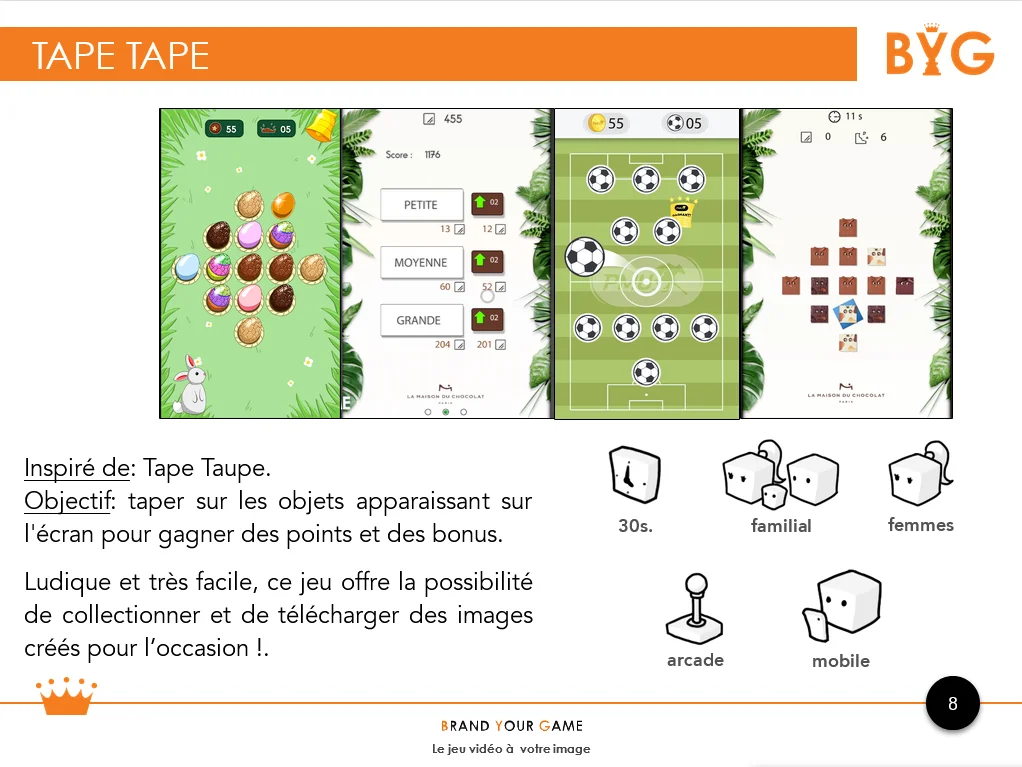
In our catalog, Bubble Hunter was called “Tape Tape”, after whack-a-mole (tape-taupe in French): tap the objects that appear on screen to earn points and bonuses. And, much to our dismay, it was the one clients picked first. We pitched it to several clients: the mechanic is extremely simple, and the cross-selling and unlockable pictures appealed to brands that wanted to show other sides of their marketing campaigns.
What I take away
Bubble Hunter really is a mini-game. As it stands, I find it well finished: design, sounds, animations, mechanics. But it lacks somewhat deeper gameplay to make it what I call a “game”. Adding the score grids and skins is what will make all the difference in Easter Hunter.
To see how a player progresses through their first games, the video below follows the first minutes of play.